
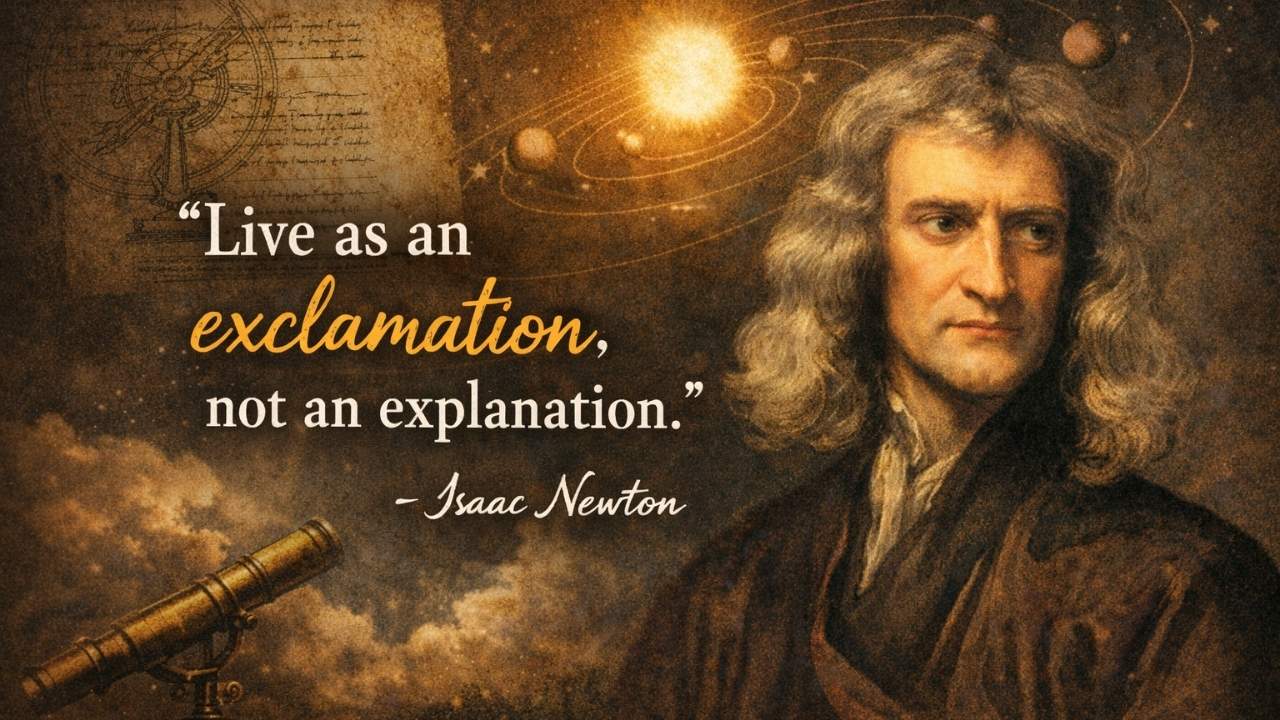
Sir Isaac Newton is widely regarded as one of the most influential scientists in human history. His work in physics, mathematics, and optics fundamentally changed the way people understand the universe. Through his research, he introduced concepts that explained motion, gravity, and the behavior of light. His most famous work, Principia Mathematica, published in 1687, laid down the laws of motion and universal gravitation, which remained central to science for more than two centuries.
Over time, Newton’s name has become associated not only with scientific discoveries but also with motivational and philosophical quotes. Books, websites, and social media platforms widely share one such statement, “Live your life as an exclamation rather than an explanation.” Although the quote is inspiring and easy to understand, its direct connection to Newton is still uncertain.
Table of Contents
Detailed Quote and Its Meaning
“Live your life as an exclamation rather than an explanation”
The quote carries a practical and motivational message. It highlights two different ways of living, one based on explaining and the other based on doing.
An “explanation” often reflects a mindset in which a person spends time justifying decisions, defending actions, or seeking approval from others. This approach may involve talking more about plans and intentions than actually achieving results. In contrast, an “exclamation” represents a life driven by action, where efforts, achievements, and consistency naturally demonstrate one’s intentions.

In real-life situations, this idea encourages individuals to focus on productivity and meaningful work. Instead of repeatedly explaining goals or reasons, people can let their performance speak for them. This approach builds trust, credibility, and confidence over time.
While the wording of the quote appears modern, its message aligns with widely accepted ideas about discipline, accountability, and action-based success. However, it is important to note that this interpretation reflects contemporary thinking, and there is no confirmed evidence that Newton expressed this exact idea in his writings.
The Question of Authenticity
There is no reliable historical record that confirms Isaac Newton wrote or spoke this quote. Scholars who have studied his letters, notes, and scientific works have not found this statement in any primary source.
Because of this, people usually say the quote is “widely attributed” to Newton rather than officially verified. This distinction is important, especially in academic and factual discussions, where accuracy matters. Misattributed quotes can often spread over time, especially when linked to well-known figures.
Interpreting the Message in Modern Life
Even though the origin of the quote is uncertain, its message remains relevant today. Modern professional and educational environments often focus on results, performance, and measurable outcomes.
Many situations evaluate people based on their achievements, not on their promises. This makes the idea of prioritizing action over explanation particularly meaningful. It encourages individuals to demonstrate their abilities through consistent effort and visible progress.
Modern productivity principles, which value execution and discipline over repeated planning or justification, closely align with this approach.
Early Life of Isaac Newton
Isaac Newton was born on 25 December 1643 (4 January 1644, according to the modern calendar) in Woolsthorpe, Lincolnshire, England. He was born prematurely, and his father had passed away before his birth. Although he faced many personal obstacles in his early years, he demonstrated early academic promise.
Newton received his early education at local schools before joining Trinity College, Cambridge, in 1661. A significant turning point in his life came during the plague years of 1665-1667, when the university was temporarily closed.
During this period, Newton worked independently at home. It was during these years that he developed early ideas in calculus, optics, and gravity. This phase, often called his “annus mirabilis” or “year of wonders,” had a major influence on his future discoveries and scientific approach.
Popular Quotes Linked to Newton
Many quotes are commonly associated with Isaac Newton, though not all have strong historical evidence. Some of the most frequently cited statements include:
- “If I have seen further, it is by standing on the shoulders of giants.”
- “What we know is a drop; what we don’t know is an ocean.”
- “Truth is ever to be found in simplicity.”
- “I can calculate the motion of heavenly bodies, but not the madness of people.”
- “Live your life as an exclamation rather than an explanation.”
Among these, the first quote is well documented in Newton’s correspondence. The others are popular and widely shared, but their original sources are not always clearly confirmed. This highlights the importance of verifying the historical accuracy of such quotes.
Why the Quote Remains Popular
The continued popularity of this quote can be linked to modern values and communication trends. In today’s fast-paced world, people often value clear results and visible achievements over lengthy explanations.
Motivational quotes that are short, impactful, and easy to remember tend to spread quickly on digital platforms. Social media, blogs, and online articles play a major role in circulating such content. As a result, even quotes with uncertain origins can gain widespread acceptance when they resonate with people’s experiences.
The message of this quote aligns well with ideas of productivity, efficiency, and self-discipline, making it appealing to a wide audience.
Relevance in Everyday Life
The concept behind this quote can apply to various situations in daily life. In professional settings, individuals are often judged based on performance, deadlines, and outcomes rather than explanations. Similarly, in education, people value consistent effort and results more than intentions alone.
Focusing on action helps build credibility and trust over time. When people consistently deliver results, they do not need to explain themselves frequently. Their work becomes their strongest statement.
However, it is also important to maintain balance. While action is important, communication and explanation are still necessary in teamwork, leadership, and decision-making. The key is to support words with meaningful actions.