
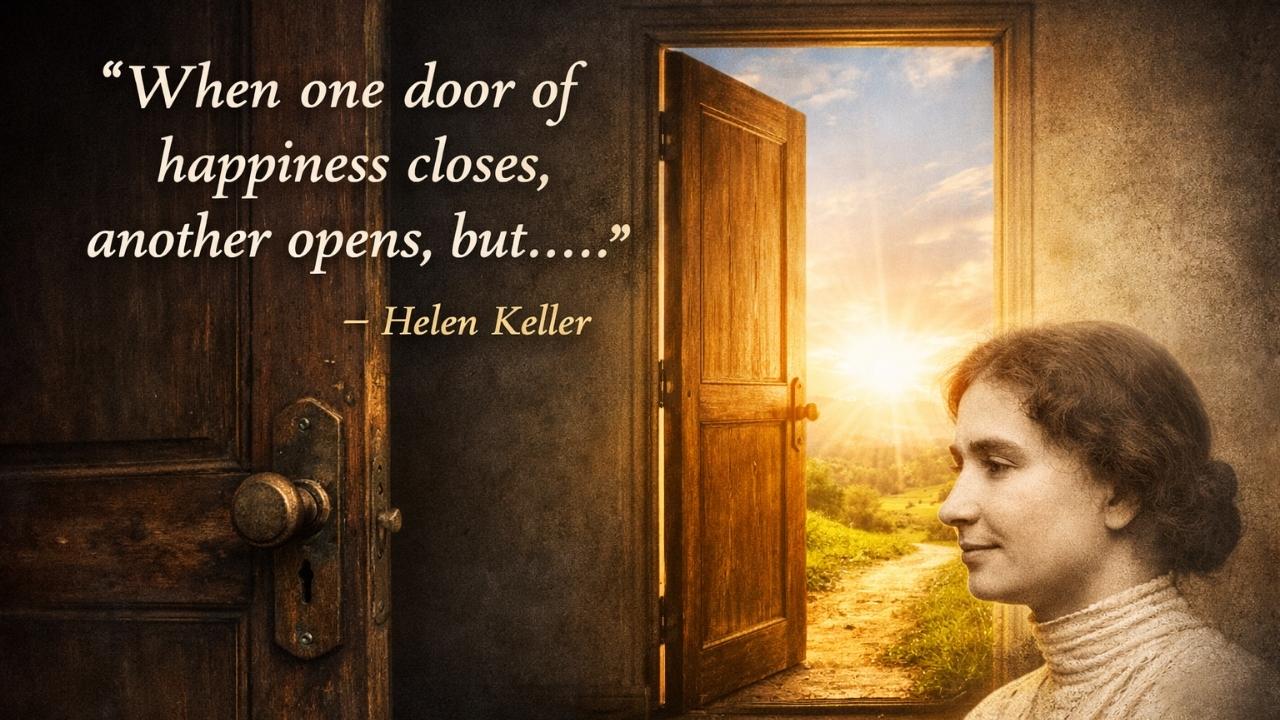
Helen Keller remains one of the most respected figures in the history of human resilience, education, and disability advocacy. Born in 1880 in Alabama, she faced a life-changing illness at just 19 months old that resulted in the loss of both her sight and hearing. Despite these challenges, she achieved milestones once thought impossible.
Through disciplined learning, strong mentorship, and determination, Keller became the first deafblind individual to earn a Bachelor of Arts degree in 1904. This achievement transformed her life and reshaped global perspectives on education for individuals with disabilities. Her journey continues to motivate educators, students, and leaders around the world.
Table of Contents
Understanding the Famous Quote

One of Helen Keller’s most widely shared thoughts is:
“When one door of happiness closes, another opens, but often we look so long at the closed door that we do not see the one that has been opened for us.”
This statement has remained relevant across generations because it reflects a universal human experience. It does not simply offer comfort; instead, it highlights a behavioral pattern: people tend to focus heavily on loss while overlooking new possibilities that may arise at the same time.
Her writings garnered the quote’s attention, leading to its inclusion in her book We Bereaved (1929). Over time, it has been repeated in various educational, motivational, and leadership contexts due to its practical and psychological relevance.
Deeper Meaning and Practical Interpretation
At its core, the quote explains how human attention works during times of change or disappointment. When something valuable is lost, whether it is a job, a relationship, or an opportunity, people naturally dwell on that loss. This emotional focus can become so intense that it blocks awareness of new options that may already be present.
Rather than presenting a purely optimistic message, Keller’s words describe a realistic observation. Opportunities do not always disappear after setbacks; they are often missed because the mind remains fixed on what has ended.
Modern psychological research supports this idea. Studies on attention and decision-making show that individuals who remain focused on negative experiences are less likely to recognize alternatives. On the other hand, those who consciously shift their attention toward possibilities tend to adapt more effectively and make better decisions.
Early Life and Learning Breakthroughs
Helen Keller’s transformation began in 1887 when Anne Sullivan became her teacher. Sullivan introduced innovative teaching techniques that relied on touch and association. By spelling words into Keller’s hand and connecting them with real objects, she helped Keller understand language for the first time.
This breakthrough marked the beginning of Keller’s academic journey. She gradually learned to read, write, and communicate, eventually entering formal education. Her capacity to learn through tactile methods emerged as a pivotal case study in educational psychology.
One of her early creative works, The Frost King, written in 1891, brought attention to her developing literary skills. Although the work later sparked discussions about originality, the incident played an important role in refining her learning methods. It led to greater emphasis on structured reading and guided writing, which strengthened her future work.
Growth as a Writer and Thinker
Keller’s literary journey expanded significantly as she matured. Her autobiography, The Story of My Life (1903), became a widely read account of her experiences. It offered readers a detailed understanding of how she overcame communication barriers and pursued education.
Over time, she wrote more than a dozen books and numerous essays. Her writings explored themes such as education, equality, disability rights, and social justice. These works were not only personal reflections but also powerful contributions to public discourse.
Her ability to communicate complex ideas despite sensory limitations demonstrated the potential of adaptive education and inclusive learning systems.
Public Life and Global Impact
Helen Keller’s influence extended far beyond writing. She became a prominent public speaker and traveled across countries to advocate for the rights of people with disabilities. Her lectures reached thousands of people, helping to change attitudes toward blindness and deafness.
She also worked with several organizations focused on rehabilitation, education, and social inclusion. Through these efforts, she contributed to policy discussions and awareness campaigns that shaped modern approaches to disability support.
By the time of her passing in 1968, Keller had received numerous awards and honors. Her life’s work had a profound effect on both education systems and social attitudes worldwide.
Notable Quotes by Helen Keller
Helen Keller’s writings and speeches include many memorable lines that still motivate readers. Some of her most frequently cited quotes include:
- “The best and most beautiful things in the world must be felt with the heart, not seen or touched.”
- “Life is either a daring adventure or nothing.”
- “Keep your face to the sunshine, and you cannot see the shadows.”
- “The chief handicap of the blind is not blindness, but the attitude of seeing people toward them.”
- “When one door of happiness closes, another opens…”
These statements reflect her consistent focus on human dignity, perception, and the importance of inner strength.
Relevance in Today’s World
In modern society, people frequently experience change, whether through career shifts, academic challenges, or personal setbacks. Research shows that large numbers of individuals change jobs or face unexpected disruptions each year.
Many individuals focus on what they have lost in such situations. This often reduces their willingness to explore new opportunities, such as skill development, career transitions, or support systems.
Keller’s quote remains relevant in this context. It highlights the importance of redirecting attention rather than staying attached to past outcomes. In the digital era, where social media often amplifies comparison and negativity, this message becomes even more important.
Those who consciously shift their focus to available options tend to adapt and move forward more effectively. This makes Keller’s words not just inspirational but also practical in real-life decision-making.